
I've already mostly forgotten what this book was about. To be fair, I read it almost three weeks ago, but I think it'd be equally fair to say that you don't forget the good books. Even the bad books are memorable in some way; even if they're not exactly pleasant memories. This one was just one forgettable, mediocre book. Something that was hard to remember even when I was reading it, which is honestly just an impressive display of nothingness.
What vague memories I have of it allow me to tell you that it was about a boy who was raised as a girl by his big weirdo of a father. The story was set in England in the 17th Century or so, most of it taking place in a big, boring, empty mansion. The boy, called Rose, was abandoned and later picked up by a very rich nobleman, who for some ridiculous reason decided to bring him up as a girl with the help of his mother's nurse. Rose grows up, has a couple of friends and as he hits his teenage years--well, you can probably guess what happens. All is revealed. Rose runs away and goes on some frankly bizarre and confusing adventures, then comes back and everything is tied up neatly in a big fat bow of Happily Ever After--something about wearing a dress while also having a beard...I don't know. It's not important.
Nothing ever felt important. The story is told by Rose, and, if there's something I've learned while doing the Cannonball is that very, very few people know how to do a good first-person narration. It takes a very good writer to manage the technique, and William Stace just isn't that good, and Rose came off as exceedingly whiny and pathetic a narrator. One who is also rather unlikable. And when you start off with an unlikable main character and you give them nothing good to be surrounded by- no fleshed-out supporting characters, no exciting dialogue, no real plot, not even a good mystery-- you just have a big pile of nothing on your hands.
I can't even get worked up enough to hate it. Stace is not a terrible writer, but he started out with a weak story that never really got going. I confess I spent most of the last quarter of the book skipping large paragraphs of boring, useless exposition in an attempt to just get the book finished. I even put off writing this review for a very long time--the book was so boring that I didn't even want to relieve it long enough to write this.
Thursday, April 28, 2011

Tuesday, April 19, 2011
Work, books, family...
Apologies for this place being so quiet lately. But I've had a few things going on that have kept me both from updating and reading in general, which makes me sad in the pants.
First, I got a job! I won't say the company name here, but I'll tell you it's a high-end retail store at a mall here in Dallas. I'm on my third week and so far I'm liking it just fine. It can get pretty hectic sometimes--this week in particular has been rather insane-- but the good thing is that the busier you are, the faster the time goes by. I have a problem with sitting still doing nothing, which just makes long shifts drag by, so keeping busy is a good thing. I do get home exhausted after a long day (specially given that I spent the last three months sitting around doing nothing all day), but my feet are finally getting used to the activity. To top it all off, I'm making good money and I'm able to help with household expenses, which is always nice.
I still want to go for the teaching degree, of course. But given the state of Education in Texas right now, I think I'd better put if off for a while. I think I'll still try to get the certification this year just to have it on hand for when schools start hiring again, but that will have to wait until I'm a little bit more secure at the job. So, it's not an ideal situation, but I have a job and I'm very grateful for that.
Specially because a brutal summer is coming and I want to be able to use the A/C all day without feeling guilty at not being able to afford it. Bwah.
In other news, my older brother's going to be moving to Dallas with his wife, and I couldn't be more excited. They just got married in December and they'll be moving here for school sometime during the summer. I'm ecstatic at having some family nearby, and the fact that we'll both be here will make it a lot easier for the rest of my family to visit us. It'll be fun.
As for my Cannonball, I'm going along at a good pace. I'm on book 22 and not that far behind on my reviews. I decided to lump all of the Sookie Stackhouse books into one giant review, as separate posts would be too repetitive and full of spoilers. I'm on book 8 right now and should be done pretty soon.
That's about it on this end. Nothing terribly exciting, but I'm keeping busy while trying not to melt. It's already hitting 95 here during the day, with lows in the 80s at night. I did not miss you, summer.
Friday, March 25, 2011
Book #13: "The Constant Gardener" by John Le Carre
John Le Carre is an amazing writer. That was the main thing I got out of this fantastic, thrilling book. I don't know why I'd never read any of his work before, but after this one, I think I'm going to need to pick up more than a few of his books. He has this incredibly simple but elegant way of writing, where the sentences just flow perfectly together and draw you into the story so well that before you know it you've read half the book in just a few hours.
The book (on which the movie was based) takes place in Kenya, where the British High Commission works to aid the impoverished nation. Justin Quayle for for the BHC, and is married to Tessa, a passionate young woman determined to really help the population in Kenya by fighting the corporations that want to make a profit from pretending to help them. At the start of the book (it's not a spoiler, as it happens in the first page), Tessa is found murdered, and Justin begins to investigate the details behind her very suspicious death. He soon finds out that Tessa was involved in uncovering the truth behind the deaths of Kenyans who were using a drug promoted by a rich pharmaceutical company, and that they might be responsible for her death. The story quickly escalates into a dangerous mission for Justin, as he travels around the world trying to find out the truth behind his wife's murder.
It's a great thriller of a story, and Le Carre keeps things moving at a fast pace. The book slows down slightly in the middle as Justin hops to yet another international destination, but it's still a fun read. Le Carre writes some great characters, all with distinct voices and personalities, and you really do end up caring a great deal about Tessa and Justin. The story might be unrealistic at times, but I think that when a thriller is really good, you don't really care that much.
All in all, I loved this book. The writing is a pleasure to read, the mystery is engrossing, and the characters are believable. I don't ask for much more from a thriller, and this one delivered. I highly recommend it.
PS: The movie is also pretty great. But so very, very depressing.
Tuesday, March 15, 2011
Book #12: "Lisey's Story" by Stephen King
Oh, Stephen King, I wish I knew how to quit you. Even when you give me this bizarre, often-irritating mess of a book, I still find things to like about it. And I know I'll still read whatever you write, even when I (and pretty much the entire world) have a feeling that maybe you should have stopped a long time ago.
Lisey's Story is a strange soup made up of a confusing mix of the ingredients Stephen King loves and that we long-time readers are all too familiar with: There's the story told from a lonely woman's perspective; a woman who is so normal she's almost dull. The dead husband, who (of course) was a famous author. Their loving relationship and his dark past. The Maine setting. And as always, a sprinkling of the supernatural--in this case, a very convenient parallel world that only very special people can travel in and out of with relative ease. As usual with King, most of the ingredients work for most of the book, up until the end when they start to go a little stale.
Lisey is a fairly dull woman who lost her husband, Scott (a famous writer), a couple of years ago. She's finally going through his effects after being pushed to it by former peers of her husband who want any unwritten material he might have left behind. As she goes through his papers, she finds herself reliving moments in their life, including some very dark memories that she has blocked out of her mind. She then discovers that before his death, Scott left behind a trail of objects and papers that would take her further and further back into his very dark past and make her remember all those suppressed memories. It's like a miserable scavenger hunt, that Scott calls a 'bool' for some unexplained reason (more on this later). Lisey follows along, mostly because she doesn't have much of anything else to do.
It's actually all pretty interesting stuff to read--up until the point where King's train goes off the believable trail and crashes into that damned parallel world that he's so fond of. I would try to explain the parallel world here, but it would spoil the story for those who might consider reading it. And to be perfectly honest, it just doesn't make much sense at all. It actually ends up seeming like nothing more than a convenient device that makes plot points easy to resolve--as if King couldn't think of a good way for Lisey to solve her problems. It just doesn't make a whole lot of sense, and sometimes the story veers into outright silly territory because of it.
One of the things I've always loved about King is that he writes believable, relatable characters. He's great at giving his characters a voice, so that you feel like you know them after only a few pages. Often, he does this by giving the characters cutesy little sayings like the kind your elderly aunt uses, and it works pretty well most of the time. But in this case, I just found this irritating. It's true that married couples often use cute little nicknames for things, little in-jokes that only the two can understand, and I get that using them in a story is a good way to draw a realistic couple. But Lisey and Scott are just ridiculous. Every damned thing has a cute little nickname, and I just found myself thinking that I would probably hate the living guts out of Scott if I ever met him. Sure, it might be cute between the two of you, but I don't want to hear the stupid little name you have for going to the toilet. No one does. Keep that stuff to yourself.
The weird thing is, I don't remember disliking the book this much while I was reading it. I know that the nickname thing did irritate me, and that the parallel universe seemed ridiculous as I read. But Lisey's actual trip back through her memories is actually a pretty good read--it's just that it's sprinkled throughout with all these annoying little details that take you away from the story, and that, when you think about them at the end, make you realize that the book was kind of a mess. And I haven't even gone into the superfluous subplots (Lisey's sister, the psychotic fan) because they seem to be part of a completely different story. I feel that, had King stuck to the one story of Lisey and Scott (and maybe a better version of the parallel world) the book would have been infinitely better. But, as is usual with him, he just has to keep adding more and more elements to the book, so that it ends up being a bloated, unappetizing mess. In the end, I liked some of it. Most of it I didn't, and once again I got the feeling that it could have been a better book if he had spent a little more time on it. One of King's problems is that he writes so much that a lot of his books don't read like he's put a lot of effort into them. And this was one of those.
So, unless you're a die-hard fan of Stephen King like I am, I'd recommend skipping this book. We die-hards will indulge him in all his weirdnesses and continue to read him even after he irritates us, but someone else might not be so kind. While I go "oh, another parallel universe? OK, then" someone else might just think the whole thing is ridiculous and stop reading the book. And that would probably be a smart move in this case. At least you'll be spared the disappointment.
It's not a very healthy relationship, mine and King's. But I can't quit it. There's always the hope of something better coming along the way, even if I have to put up with a lot of crap along the way.
Monday, March 14, 2011
Monday Hot Post: Figgy's New Crushes
I've given my blog over to my 15 year old self today, who, to be perfectly honest, is within 2 seconds of Normal Me at any given time, ready to take over at the mere sight of a really pretty boy on my TV. As I said over in the Twitterverse: I sincerely hope I never get too old to stop getting crushes on random male celebrities. What do you want from me? I'm allowed to like the pretty! MrFig told me so*. Plus, I need a distraction from waiting around and being stressed and dammit, it's my party and I'll objectify if I want to.
*I gather this from the fact that he just narrows his eyes and shakes his head when I point out how cute so-and-so is. I wonder if he'll read this and shake his head some more. Hi, honey!
Today's post is testament to the fact that my crushes are easily interchangeable, depending mostly on what my thirty-second attention span is focusing on at that moment. I mean, there's always the Unshakable Freebies (Eric Bana, Sean Bean, Christian Bale), but some crushes fade as they leave my screen, like Naveen Andrews or Reynaldo Giannechini. What can I tell you? My love, like life, is fickle. A leaf turning in the wind, drifting down the stream--
Oh god, shut up and show us some hot mens. Alright. Here we go.
1. Kyle Chandler

Hey, have you watched Friday Night Lights yet? Why the hell not? Don't be an idiot like I was for so long and stay away from one of the best shows of all time because you think it's just about football. Because it SO is not. It's brilliantly written and acted, and I've never seen such realistic portrayals of people and relationships before. It's amazing and you should all watch it. Plus, there's Taylor Kitsch goodness.


And look at that pretty, pretty smile!
Ooh, Kyle Chandler. One manly clench of that jaw, one look at that bristling head of hair and I'm a puddle of goo. He wears shorts and sneakers and still looks incredibly good. And he's got a voice to melt butter. Oh, Coach. You and your magnificent head of hair make my life happier.
Speaking of magnificent heads of hair...
2. Adam Scott

OK, this one's a little bit different for me. He's almost the complete opposite of my type--he's short, really skinny, and kinda weird looking. I mean, he has a giant head. And his hair makes him look like a hedgehog. But damn, this guy's got something that makes me giggle like a 15 year old.

Lemme give ya a little eyebrow
It's partly the fact that he's incredibly funny (speaking of shows you should watch, have you tried Party Down or Parks and Recreation? Because you seriously should) and has these incredible reactions to everything, and then he has this great voice, and the eyebrows, and just... HE IS SO DAMN CUTE:

And hedgehog like...

*Ahem* Yeah, I really can't get any more eloquent than that. I think this is a guy you need to watch act to get his appeal, though damn, he's cute in photos, too. He's quickly shot up my list of favorites, and I'll never tell anyone just how many times I've watched both of his shows lately. Over and over and over again. I have a problem.
Now, on the complete opposite side of the spectrum, we have...
3. Chris Hemsworth

Or as I like to call him: The Hemsworth that matters. The first time I looked at this dude I dismissed him as too pretty for my tastes. He's a former model and looks it, in those cheesy little poses. And then...oh, my.

I'm not even gonna beat around the bush on this one (*giggletitterIamagiantidiot*): the guy is huge. A mountain of a man. I mean, he's playing freakin' Thor, for crying out loud. And what with my complete obsession with any movie featuring superheroes, and, well, this:

And this:

The hammer is his...oh, shut up
Um...how soon can I get tickets?
Speaking of movies I can't wait to see...
4. Richard Armitage

This sexy-voiced Brit first came to my attention after a friend recommended I watch the mini-series North and South, one of those dark-and-gloomy British period pieces. I loved it. He spent a lot of time brooding. In an incredibly sexy manner, of course:

*broodbroodbroodbesexybroodbroodbrood*

*broodbroodbroodgloomysexystarebrood*
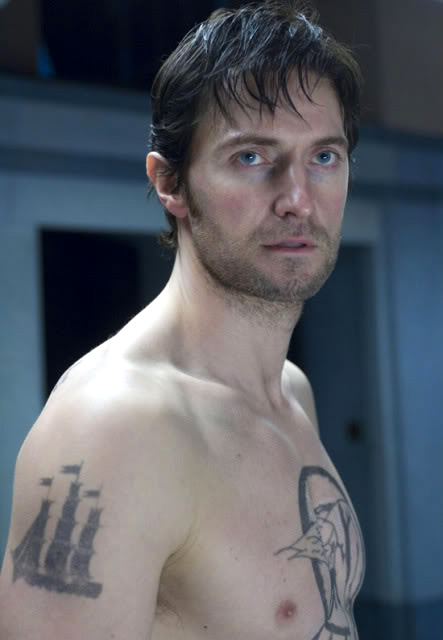
His upcoming film? The Hobbit. Yeah, that one. Alas, he'll probably be all covered up in hair and many layers of clothes, so we won't get to see him like this:

Hey, PJ? I have an awesome idea for the Thorin character...
***
Well, that's it for now. I hope you enjoyed looking as much as I enjoyed putting this damned thing together.
May we never stop liking to look at the pretty men.
*I gather this from the fact that he just narrows his eyes and shakes his head when I point out how cute so-and-so is. I wonder if he'll read this and shake his head some more. Hi, honey!
Today's post is testament to the fact that my crushes are easily interchangeable, depending mostly on what my thirty-second attention span is focusing on at that moment. I mean, there's always the Unshakable Freebies (Eric Bana, Sean Bean, Christian Bale), but some crushes fade as they leave my screen, like Naveen Andrews or Reynaldo Giannechini. What can I tell you? My love, like life, is fickle. A leaf turning in the wind, drifting down the stream--
Oh god, shut up and show us some hot mens. Alright. Here we go.
1. Kyle Chandler

Hey, have you watched Friday Night Lights yet? Why the hell not? Don't be an idiot like I was for so long and stay away from one of the best shows of all time because you think it's just about football. Because it SO is not. It's brilliantly written and acted, and I've never seen such realistic portrayals of people and relationships before. It's amazing and you should all watch it. Plus, there's Taylor Kitsch goodness.


Ooh, Kyle Chandler. One manly clench of that jaw, one look at that bristling head of hair and I'm a puddle of goo. He wears shorts and sneakers and still looks incredibly good. And he's got a voice to melt butter. Oh, Coach. You and your magnificent head of hair make my life happier.
Speaking of magnificent heads of hair...
2. Adam Scott

OK, this one's a little bit different for me. He's almost the complete opposite of my type--he's short, really skinny, and kinda weird looking. I mean, he has a giant head. And his hair makes him look like a hedgehog. But damn, this guy's got something that makes me giggle like a 15 year old.

It's partly the fact that he's incredibly funny (speaking of shows you should watch, have you tried Party Down or Parks and Recreation? Because you seriously should) and has these incredible reactions to everything, and then he has this great voice, and the eyebrows, and just... HE IS SO DAMN CUTE:


*Ahem* Yeah, I really can't get any more eloquent than that. I think this is a guy you need to watch act to get his appeal, though damn, he's cute in photos, too. He's quickly shot up my list of favorites, and I'll never tell anyone just how many times I've watched both of his shows lately. Over and over and over again. I have a problem.
Now, on the complete opposite side of the spectrum, we have...
3. Chris Hemsworth

Or as I like to call him: The Hemsworth that matters. The first time I looked at this dude I dismissed him as too pretty for my tastes. He's a former model and looks it, in those cheesy little poses. And then...oh, my.

I'm not even gonna beat around the bush on this one (*giggletitterIamagiantidiot*): the guy is huge. A mountain of a man. I mean, he's playing freakin' Thor, for crying out loud. And what with my complete obsession with any movie featuring superheroes, and, well, this:

And this:

Um...how soon can I get tickets?
Speaking of movies I can't wait to see...
4. Richard Armitage

This sexy-voiced Brit first came to my attention after a friend recommended I watch the mini-series North and South, one of those dark-and-gloomy British period pieces. I loved it. He spent a lot of time brooding. In an incredibly sexy manner, of course:


His upcoming film? The Hobbit. Yeah, that one. Alas, he'll probably be all covered up in hair and many layers of clothes, so we won't get to see him like this:
***
Well, that's it for now. I hope you enjoyed looking as much as I enjoyed putting this damned thing together.
May we never stop liking to look at the pretty men.
Friday, March 11, 2011
All my Cannonball 1 Reviews
This is more for my own benefit than anything else, but I thought this would be a handy post to refer to when I mention books I've read in the past. These are all the reviews I wrote for the first Cannonball, way back in '08 and '09. It's funny to see how I started out strong with the reviews, then got to around 40 books and I totally deflated. But, in my defense, that was around the time of the coup in Honduras and the nightmare with getting my visa, and writing book reviews was the farthest thing from my mind. Then I just read and read and let the reviews pile up, then just never got around to writing the last 50 or so. How embarrassing. One good thing that might come of this is that I've learned a lesson and won't let the reviews wait too long.
Anyway. There's some good stuff in here, and I had fun putting the list together and reading through some reviews. I like how I go from High-Fallutin' Intellectual Wannabe to Cussing Like a Pirate and Not Really Trying from one review to the next. I'm nothing if not inconsistent.
1. "The Time Traveler's Wife" by Audrey Niffenegger
2. "Everything is Illuminated" by Jonathan Safran Foer
3. "Why Girls Are Weird" by Pamela Ribon
4. "Everything's Eventual" by Stephen King
5. "Embers" by Sandor Marai
6. "The Witch of Portobello" by Paolo Coelho
7. "On Writing" by Stephen King
8. "A Thousand Splendid Suns" by Khaled Hosseini
9. "Night Sins" by Tami Hoag
10. "Guilty As Sin" by Tami Hoag
11. "How to Get Lost" by Amanda Eyre Ward
12. "The Hours" by Michael Cunningham
13. "The First Wives' Club" by Olivia Goldsmith
14. "The Testament" by John Grisham
15. "The Rescue" by Nicholas Sparks
16. "When the Wind Blows" by James Patterson
17. "Confessions of an Ugly Stepsister" by Gregory Maguire
18. "The Partner" by John Grisham
19. "Hannibal" by Thomas Harris
20. "Marie Antoinette" by Hilaire Belloc
21. "Midnight in the Garden of Good and Evil" by John Berendt
22. "The Corrections" by Jonathan Franzen
23. "Ain't Gonna be the Same Fool Twice" by April Sinclair
24. "Wicked" by Gregory Maguire
25. "Cry Wolf" by Tami Hoag
26. "Teacher Man" by Frank McCourt
27. "Tiburcio Carias Andino" by Mario Argueta
28. "The Golden Compass" by Phillip Pullman
29. "The Subtle Knife" by Phillip Pullman
30. "The Amber Spyglass" by Phillip Pullman
31. "Black Hawk Down" by Mark Bowden
32. "Sense and Sensibility" by Jane Austen
33. "Lady Chatterley's Lover" by DH Lawrence
34. "Walking the Bible" by Bruce Feiler
35. "The House of Spirits" by Isabel Allende
36. "Outlander" by Diana Gabaldon
37. "Dragonfly in Amber" by Diana Gabaldon
38. "Me Talk Pretty One Day" by David Sedaris
39. "High Fidelity" by Nick Hornby
40. "Voyager" by Diana Gabaldon
41. "Bridget Jones's Diary" by Helen Fielding
42. "Drums of Autumn" by Diana Gabaldon
43. "Ender's Game" by Orson Scott Card
44. "Bridget Jones: The Edge of Reason" by Helen Fielding
45. "The Talisman" by Stephen King and Peter Straub
46. "Rainbow Six" by Tom Clancy
47. "The Godfather" by Mario Puzo
48. "The Fiery Cross" by Diana Gabaldon
49. "A Heartbreaking Work of Staggering Genius" by Dave Eggers
50. "The Godfather Returns" by Mark Winegardner
51. "Harry Potter and the Sorcerer's Stone" by JK Rowling
52. "The Street Lawyer" by John Grisham
53. "From a Buick 8" by Stephen King
54. "A Breath of Snow and Ashes" by Diana Gabaldon
55. "Airs Above Ground" by Mary Stewart
56. "Harry Potter and the Chamber of Secrets" by JK Rowling
57. "Harry Potter and the Prisoner of Azkaban" by JK Rowling
58. "To Kill a Mockingbird" by Harper Lee
59. "Jurassic Park" by Michael Crichton
60. "Smith of Wooton Major and Farmer Giles of Ham" by JRR Tolkien
61. "Good Omens" by Neil Gaiman and Terry Pratchett
62. "Son of a Witch" by Gregory Maguire
63. "The Three Musketeers" by Alexandre Dumas
64. "Harry Potter and the Goblet of Fire" by JK Rowling
65. "The Kite Runner" by Khaled Hosseini
66. "Sex and the City" by Candace Bushnell
67. "Harry Potter and the Order of the Phoenix" by JK Rowling
68. "The Outsiders" by S. E. Hilton
69. "Neverwhere" by Neil Gaiman
70. "The Hitchhiker's Guide to the Galaxy" by Douglas Adams
71. "Rage" by Stephen King
72. "The Long Walk" by Stephen King
73. "The Restaurant at the end of the Universe" by Douglas Adams
74. "Roadwork" by Stephen King
75. "The Running Man" by Stephen King
76. "Life, the Universe and Everything" by Douglas Adams
77. :So Long, and Thanks for all the Fish" by Douglas Adams
78. "Persuasion" by Jane Austen
79. "Mostly Harmles" by Douglas Adams
80. "Coraline" by Neil Gaiman
81. "Fire and Hemlock" by Diana Wynne Jones
82. "The Stand" by Stephen King
83. "The Man in the Iron Mask" by Alexandre Dumas
84. "Under the Tuscan Sun" by Frances Mayes
85. "Dolores Claiborne" by Stephen King
86. "The Da Vinci Code" by Dan 'Hack Job' Brown
87. "The Lovely Bones" by Alice Sebold
88. "Dracula" by Bram Stoker
89. "The Langoliers" by Stephen King
90. "The Library Policeman" by Stephen King
91. "To the Nines" by Janet Evanovich
92. " Day of the Triffids" by John Wyndham
93. "The Catcher in the Rye" by JD Salinger
94. "The Stranger" by Albert Camus
95. "Cuentos de Eva Luna" by Isabel Allende
96. "Desperation" by Stephen King
97. "Pride and Prejudice" by Jane Austen
98. "In Cold Blood" by Truman Capote
99. "Airframe" by Michael Crichton
100. The Brethren by John Grisham
Conclusions: I read a lot of crap there at the end, just desperately trying to make it to 100. But I did! Even if some of the books barely fit the rules. I hope to do much better this year.
Book #11: "The Ministry of Special Cases" by Nathan Englander
If there's anything I hate more than reading a bad book, it's to be disappointed by a book I thought would be good. I came into this one with high hopes, as I had heard nothing but good things about it-funny, tragic, original, etc- and I could not have been more disappointed. I'm still not sure how I got through this plodding, miserable and depressing read, but it must have been a combination of stubbornness and of my dislike for leaving any book unfinished.
The story is set in Argentina in the 1970s, during a military dictatorship; a particularly dark time in the country's history. Kaddish Poznan is Jewish, the son of a prostitute, and he specializes in erasing the names off tombs in the Jewish cemetery; specifically, the closed-off section that houses the tombs of pimps and prostitutes. He is paid to do this by wealthy Jews who don't want to be associated with their darker pasts. He's reluctantly assisted by his son, Pato, a young college student with communist leanings. His wife, Lilian, works as a secretary and dotes on their son.
One day their son disappears for seemingly no reason at all. His disappearance takes over all of Lilian's life, as she spends days and days at the Ministry of Special Cases, a bizarre building that's a bureaucratic nightmare, where people are made to wait outside in the sun for hours and days just for a turn to talk to someone who can't help them. Kaddish, less optimistic than his wife, is pretty sure their son is dead.
And I just didn't give a damn about any of it. Aside from the terrible flashbacks of Honduran bureaucracy brought up by the scenes at the Ministry, this whole book just washed over me and left me feeling completely and utterly bored. None of it ever connected; not the characters or their terrible tragedy, not the setting, nothing at all. Which was just surprising to me, because I thought that I'd readily connect to a book that deals with a story that was repeated all through Latin America in the 70s and 80s--my parents lived through this, and still I didn't give a damn what happened to any of these characters!
It's hard for me to remember why all I felt for this book was an overwhelming sense of apathy. I think a big part of it was that the characters didn't feel like real people to me. They were like ghosts, and for all that Englander documents Lilian's misery, it just felt so clinical to me. Lilian and Kaddish felt like they lived in completely different worlds, which I suppose was the point (they never connect to each other), but to me they felt like characters in two completely different stories. I never felt that the two were even remotely connected. Pato is just a sketch of a character, and it was hard to grasp just what the character was like, or why I should care about him.
The writing felt dry and heartless to me. Scenes were disjointed and there didn't seem to be a running thread through the whole thing. I think we were supposed to feel the same sense of confusion and isolation that Lilian felt in her search for her son, but I don't think we were supposed to feel completely outside of it, to the point where you just stop caring about the whole thing.
I don't know if this will make much sense to anyone, but to me, the book felt like a bad Spanish-to-English translation of a better book. It felt as if the words didn't quite fit, as if they would maybe have more of an impact in a different language; as if it had been written by a very dry, very bad translator. The words just didn't fit the story. I really hate that I can't explain it any better than that, but maybe it'll make some sense to someone.
I came into this with high expectations, and they were dashed pretty quickly. I kept expecting the story to pick up, for the writing to get smoother, to start caring about the characters. But that never happened. Though there are scenes of graphic violence and what I guess is supposed to be terrible sadness, I never felt anything but apathetic towards this book. I didn't hate it; I just didn't care.
I guess they can't all be winners. I'm just annoyed that this one wasn't.
Thursday, March 3, 2011
Book #10: "Diary of a Manhattan Call Girl" by Tracy Quan
Oh, sweet Jeebus on a cracker, what a terrible turd of a book this was. Let me tell you the many, many ways in which this book quickly launched itself to the very top of my Trash list.
Our protagonist, Nancy Chan, is a high-end call-girl. She has always wanted to be a prostitute (um...ok, whatever), and at 20 something she's raking in the money by having sex with creepy, rich, old guys. She is also -oh, no! the conundrum!- engaged to a rich, incredibly bland dude (more like a cardboard cutout for all the personality he has) and is being pressured by her ditzy friend to join a group that promotes the rights of sex-workers.
That should be...at least kind of fun to read, wouldn't you think? After all, the cover quoted "Cosmopolitan" (oh that bastion of high literature and fun, fun times!) saying that it was "chock full of dirty secrets!" (or some shit like that), so you really shouldn't expect more than a bunch of dirty sex scenes and fun in the high life of sex with balding men in their 60s! The cover had a BUTT on it! How could we go wrong in our pursuit of a mindlessly fun book to read quickly in boring moments? HOW!
By doing every single thing that you could possibly do wrong in writing a book. First: Make your book into a "diary", because God knows that shit isn't done to death, especially in chick-lit. Hey, it worked for Bridget Jones, and how hard can it be? Start by making your protagonist into an insufferable, spineless, whiny little victim who goes to the therapist a lot to whine about her stupid little problems that she could easily get out of if she had even the slightest bit of self-respect. Then, have her pepper her journal entries with inane little asides, a lot of "dirty" words (Oh, my! she said "pussy"! How naughty!) and a lot of boring stories about having sex with disgusting old men who want to have sex with young girls and pay to do it in fancy hotels in between business meetings. Have her friends be walking, reprehensible female stereotypes of the worst sort (Allison is ditzy! Jasmine is a total power slut! Her fiance's sister is a bitch because she's got a powerful job!) , and add a fiance who seems to be a complete fuckwit who somehow hasn't discovered that his fiance is a prostitute. Add to it a painfully boring subplot involving a bunch of bra-burning feminist stereotypes, a lot of seriously pathetic 'dramatic' moments (oh, no! she forgot to bring condoms! WHAT IS SHE TO DO!) and you have just one big painful insult to not only women and prostitutes, but to the entire world and very existence of books.
Just...holy hell, this book was irritating. Worse, it was boring. It starts off with one of those stupid little sex scenes that seem to have been written by a 15 year old girl who isn't quite sure how sex works but thinks that saying 'pussy' and 'cock' and 'whore' a lot immediately makes something titillating. But, no. It's just boring. You might as well be reading a recipe book for all the excitement that's in it. Nothing even remotely exciting happens to this chick, but somehow she does nothing but whine about how difficult her life is, mostly because she has incredibly stupid friends. I wanted to take this girl aside and just tell it plain to her face: If something in your life is giving you shit, get the fuck rid of it. If your friend is a pain in the ass who makes you do things you don't want to do, and she irritates the hell out of you, why are you friends with her? If you are conflicted about keeping your whoring life secret from your fiance, whom you don't really seem to have any real connection with, why don't you either tell him or break it off? You, young lady, are a spineless coward and need to get your life straight. It's not that fucking hard.
I'm devoting way too much time to this book, and I know it. But like I said in my last entry, when you hate something, you can pretty easily think of a million different reasons why you hated it. Believe me, I could keep going on and on with this, but suffice it to say that this book was a waste of my time and a perfect 99 cents. I could have bought a cup of tea with that money, and it would have been an infinitely more entertaining exercise. I could use it as a doorstop and it would serve a better purpose than as literature.
Oh, here's a fun tidbit I found out after I read the book. Apparently, Tracy Quan started this whole turd of a 'series' by writing it as a column for Salon, she's a former call-girl herself and probably most of the book was written from experience. Thanks, wikipedia. Now I have an even bigger reason to dislike this woman--you have all this wealth of probably great stories in your life, and this is what you chose to unleash on the world? Maybe you could have been better off selling your stories to someone who could actually write a sentence without sounding like a whiny teenager. Because, lady, your book sucked.
Saturday, February 26, 2011
Book #9: "The Curious Incident of the Dog in the Night-Time" by Mark Haddon
If I've discovered one thing in the course of reading and reviewing books for the Cannonball, this is it: It's much, much harder to review a great book than a bad one. It's so much easier to list all the wrongs of a bad book, to make the review humorous or to rain insults down on an incompetent author. But reviewing a good book? That's always difficult.
This was a great book. It's a story told from the point of view of Christopher Boone, a 15 year old with Asperger's syndrome. He is great at mathematics and very logical, but has little to no social skills and has trouble communicating with anyone he is not familiar with. He lives with his father, a simple man who sometimes loses his temper when he can't understand what Christopher wants.
The story begins with Christopher finding his neighbor's dog dead in the garden. Due to his love of detective stories (because of their use of logic) he decides to investigate the dog's death and find out who killed it. But he runs into trouble when people get angry or bothered by his inquiries, so much so that his father forbids him to continue the investigation. But Christopher, who has trouble understanding people's motivations and non-specific requests, finds a way around his father's orders and continues to investigate. Along the way he finds out some unpleasant things about his father and decides to run away, which throws him into a completely unknown and very confusing world as he tries to find his way around.
It's one of those stories where the things that happen to a protagonist may not be that spectacular or exciting, but because the character is so different and lives in his own little world, just going down an unknown street is an epic adventure. Christopher's voice is so strong that you get completely immersed in his story, feeling his terror at what we would consider every day things, like taking the train or having a conversation with a stranger.
In short, Haddon does a terrific job of showing the workings of Christopher's mind; how he uses his condition to work out problems, in ways that most of us wouldn't even begin to think of. It's hard to say exactly why this book is so great--it's just the way the character is written, the humor of the writing, and how you feel sympathetic of the character without feeling sorry for him. I read that Haddon based Christopher on people he knew who suffered from similar conditions to the character's, and it helped me to appreciate that Haddon doesn't consider his character as inferior, just different. And so, it's a different book from anything I've ever read, and I'm glad I finally decided to read it after many years of having people recommend it to me.
See? That was probably grossly incoherent. It's just damned hard to really explain that "I loved it, but it's hard to describe exactly why--you should just read it" feeling. Specially when any description of the story doesn't really do it justice. So I'll conclude by just saying this: It's a great book. You should read it.
Saturday, February 19, 2011
Book #8: "Heart-Shaped Box" by Joe Hill
What a great book this was. I've had people recommend it to me for ages; a lot of people going with the "He's like his dad...but BETTER!" line of encouragement. Well, I'm glad I listened.
Joe Hill is Stephen King's second son, and as much as I'm tempted to compare his writing to his father's (of whom I am a big fan, as you probably know) I think it would be doing him a disservice. Based on this book, I think his writing stands alone.
Heart-Shaped Box is a ghost story, and probably the best one I've ever read. The protagonist is Judas Coyne, a retired heavy-metal star who now lives in an isolated farm, his only company a cheery assistant and his current lady-friend, whom he calls Georgia (because it's easier if he doesn't call her by her real name). He has a bizarre collection of morbid objects--including a real snuff film-- and when someone informs him that a real ghost is being sold on e-bay, he buys it immediately, if only because it sounds pretty cool. The ghost (of a woman's deceased father) is "sent" in the suit the man was buried in, and soon Coyne starts seeing the old man around his house. At first he seems harmless, but it becomes increasingly clear that both the sender and the ghost don't have the best of intentions towards Coyne. After some pretty terrifying stuff starts to happen, Coyne and Georgia decide to track down the sender as a ways of getting rid of the ghost, and things get progressively weirder and more dangerous.
I don't want to give too many details as to that "terrifying stuff" (as I so eloquently put it), as it's definitely something you should be surprised by. I confess I don't read a lot of ghost stories, but I've never heard of a ghost being quite this terrifying and evil before. The best way I can put it is that it creeped me the hell out, so much so that I couldn't quite walk around the apartment at night without feeling completely disturbed. It's the kind of book that gets under your skin, and even now (almost three weeks after I finished it) I still feel slightly perturbed at the idea of this ghost following me everywhere.
The writing is well paced and lacking in any unnecessary embellishments, and Hill creates a great feeling of tension and suspense all through the book. Judas Coyne is not exactly a sympathetic character, and sometimes it's hard to get a hold of him as a person, but it works because you're not exactly sure what he's going to do or say next. He's a stranger, and that works really well in the context of the story, as we slowly learn more about him but still don't know him at all. And still, it's a powerful story, one that lingers in your brain, It makes you care about what's happening and it's never boring.
I look forward to reading more of Joe Hill's work, because this book just blew me away. And just because someone might ask, I can't really say if he's better or worse than his father. I know Stephen King's work too well and I like it too much to make comparisons. They might write in vaguely the same genre, but their writing styles are completely different. And that's a good thing for both of them.
Monday, February 14, 2011
Figgy's Favorites: RomComs Edition
I think you all know by now that despite my Tough-Talkin', Hatin' exterior, I'm kind of a big softie inside. So, while I despise everything related to Valentine's Day (except for the cheap chocolate tomorrow), I figured this was a good a time as any to write this list.
You should also know that I love Romantic Comedies. I watch them obsessively. All of them - hell, I've watched everything Kate Hudson has ever made (so now you know why I hate her), just because I want to find the gems amongst the piles of crap that Hollywood produces year after year.
These are the gems. They're the movies I'll sit and watch over and over again, the ones who'll get me all blubbery and grinning like a fool every single time I watch them. They may not be cinematic genius--most of them riddled with the same cliches as the bad ones-- but they make me happy.
For all intents and purposes I'm using this basic definition of a RomCom: A comedy centered and revolving around a love story. I like this definition because it gives me a more narrow field to work with, and because it excludes a lot of comedies that just happen to have a romance in them but that I wouldn't classify as RomComs. Some examples of this are Shaun of the Dead or High Fidelity; two great movies, but not RomComs to me. I know some people might not like that definition, but it works for me. So: Comedy and a love story at the center.
1. Bridget Jones' Diary
Best Moments: The confession, of course. The birthday scene (that look he gives her across the table? Sweet jeebus) and of course, the kiss at the end. That kiss. Ooh, honey pass me the fan.
Best Assets: Zellwegger whom I will always love for this movie alone, Colin Firth's accent and sexy stares, Hugh Grant being deliciously evil, Bridget's Parents (Slugworth and Madame Pomfrey!), Gaius Baltar as the gay friend, the soundtrack.
Best Line(s):
"Wait a minute...nice boys don't kiss like that."
"Oh, yes, they fucking do.
Dumb Thing To Get Over (But that you can get over pretty easily): Trying to make us believe that Bridget Jones is fat. But the whole point of the character is that she thinks she's fat but isn't.
2.The Truth About Cats and Dogs:
Best Moments: The conversations between the girls, the visit to the department store, the photo session, and of course, the phone conversation. Gets me all oogly every single time.
Best Assets: Janeane Garofalo at her most awesome, Ben Chaplin's accent, the dog, Uma Thurman being thoroughly likable for the first time ever.
Stupid Thing to Get Over: The ridiculous premise, the idea that Janeane Garofalo isn't as beautiful (if not more) than Uma Thurman.
Best Line(s):
"What's wrong, Abby?"
"Nothing that a rooftop and an AK-47 won't fix"
3. While You Were Sleeping:
Best Moments: The scene where she first meets the family, the Christmas dinner, the wedding, the first visit to the apartment.
Best Assets: Sandra Bullock at her most adorable, Joe Junior, Bill Pullman looking like a sexy carpenter, Peter Gallagher's insane eyebrows, the entire, ridiculously lovable family.
Stupid Thing to Get Over: The lie is pretty flimsy, but works perfectly. Also that anyone would fall in love with Peter Gallagher and his eyebrows.
Best Line(s):
"I'd say that she gets under your skin as soon as you meet her. She drives you so nuts you don't know whether to hug her or, or just really arm wrestle her. She would go all the way to Europe just to get a stamp in her passport. I don't know if that amounts to insanity, or just being really, really... likable. "
4.Bringing Up Baby:
[Note: I suppose this would fit in better under the "Slapstick Comedy" genre, but I'm putting it on here because I can.]
Best Moments: Oh, all of them. The whole movie is a succession of hilarious scenes and brilliant moments. If forced to pick one, I'd say the whole scene at the restaurant.
Best Assets: Cary Grant and Katharine Hepburn. Need I say more? Well, the leopards are pretty great, and Hepburn's wardrobe is amazing. George the dog is great.
Stupid Thing to Ignore: If you're really picky, the Walking Irish Stereotype can be a bit much for some people.
Best Lines:
"Now it isn't that I don't like you, Susan, because, after all, in moments of quiet, I'm strangely drawn toward you, but - well, there haven't been any quiet moments
5.Sleepless in Seattle:
Best Moments: the entire radio conversation at the start, Meg Ryan and Rosie O'Donnell watching An Affair to Remember, then Rita Wilson describing it, the guys "crying" over The Dirty Dozen.
Best Assets: Tom Hanks and Meg Ryan, both completely sweet and believable, the fact that this movie manages to convey chemistry between the two of them without them ever talking to each other, the kid who plays Jonah, the whole supporting cast (Rita Wilson, Rosie O'Donnell, Victor Garber, Bill Pullman, David Hyde Pierce).
Stupid Thing You Need to Ignore: Jonah somehow manages to fly from Seattle to NYC way too easily. Things were more relaxed in the 90s, but not that relaxed.
Best Line:
"You don't want to fall in love. You want to fall in love in a movie
6.Four Weddings and a Funeral:
Best Moments: All of the weddings, Rowan Atkinson as the priest, the girl learns sign language for the deaf boy, the final scene, John Hannah reading the poem at the funeral.
Best Assets: Hugh Grant as his most stammery, John Hannah and Simon Callow, Kristin Scott Thomas, the horrible wedding clothes, the pretty scenery, and Duckface.
Stupid Thing You Need to Ignore: Andy McDowell.
Best Line:
"In the words of David Cassidy in fact, eh, while he was still with the Partridge family..."I think I love you,"
7. When Harry Met Sally
Best Moments: The first conversation in the car, the conversation during Casablanca, the double date, the grand speech at the end.
Best Assets: Meg Ryan's hair, Billy Crystal's line delivery, Carrie Fisher, the horrible 80s wardrobe, the chemistry between Crystal and Ryan.
Stupid Thing You Need to Ignore: Billy Crystal is not a pretty man.
Best Line:
"I love that you get cold when it's 71 degrees out. I love that it takes you an hour and a half to order a sandwich. I love that you get a little crinkle above your nose when you're looking at me like I'm nuts. I love that after I spend the day with you, I can still smell your perfume on my clothes. And I love that you are the last person I want to talk to before I go to sleep at night. And it's not because I'm lonely, and it's not because it's New Year's Eve. I came here tonight because when you realize you want to spend the rest of your life with somebody, you want the rest of your life to start as soon as possible."
8.Love, Actually:
[I know a lot of people hate this one...but a lot of people hate fun, too.]
Best Moments: Laura Linney finally kisses her gorgeous man, Andrew Lincoln with the boards, every scene with Emma Thompson and Alan Rickman, Hugh Grant dances, Colin Firth in a pond again, every scene with Bill Nighy.
Best Assets: an incredible cast. Alan Rickman and Emma Thompson. Liam Neeson. That girl who sings "All I want for Christmas".
Stupid Thing You Need to Ignore: I don't like the storyline with the kid, or the Colin-goes-to-the-US, or the way the Laura Linney story ends. But everything else is pretty great.
Best Line:
"-Well, I was worried. I thought it would be something worse.
-Worse than the total agony of being in love?"
9.10 Things I Hate About You:
Best Moments: Heath Ledger sings (see above), the party (and the bit with the swings), the prom, Joseph Gordon Levitt tries to recruit Heath Ledger.
Best Assets: the cast, including Heath Ledger at his sexiest, Joseph Gordon Levitt being adorable (though he does nothing for me), Julia Stiles being great, the dad, the gorgeous location, Allison FRAKKIN Janney.
Stupid Thing You Need to Ignore: The stupid bet, because it's formulaic. But it's pretty easy to forget that it even exists sometimes.
Best Line:
"-Where did you come from? Planet "Loser"?
-As opposed to Planet "Look At Me, Look At Me"?
10.Ever After
Best Moments: the gypsies, the scene at the library, the bit with the ruins, the ball...hell, every scene that the two have together is quite wonderful.
Best Assets: Drew Barrymore's at her most lovable self, Dougray Scott managing to look hot even while wearing a giant cup, Angelica Houston, the beautiful locations, the couple that plays the King and Queen.
Stupid Thing You Need to Ignore: Leonardo da Vinci. It's so dumb it's kind of hilarious.
Best Line:
"-It is not fair, sire. You have found my weakness, but I have yet to learn yours.
-But I should think it was quite obvious.
11.The Matchmaker
[Yep, Janeane Garofalo again. I love her so much]
Best Moments: the singing contest, the pretend family fools the Senator, the whole trip to the Inishmore.
Best Assets: Janeane Garofalo, all of those delightful Irish accents, the scenery, Dennis Leary.
Stupid thing you need to ignore: The sex scene is terribly unsatisfying.''
Best Line:
"-Is being an idiot like being high all the time?
-No, it's like being constantly right."
*****
Honorable Mentions:
-You've Got Mail
-The Philadelphia Story
-It Happened One Night
-The Wedding Singer
-Moonstruck
So, there you go. Hope you get around to watching the ones you haven't seen. And please, be kind in the comments. Remember that these are my personal choices, and I never claim to have flawless taste. So add your own, or fight me if you must.
Wednesday, February 9, 2011
Book #7: "Dead Until Dark" by Charlaine Harris
A few of you might know that I am a huge fan of HBO's True Blood series. It's a trashy, hilarious, bizarre show that can be alternatively brilliant and mind-numbingly stupid. For all its flaws, it's quite addictive-- the presence of the gorgeous Alexander Skarsgard doesn't hurt, either, nor does the fact that he's often almost completely naked in it. A lot. And he's tall and...so...um...
*Ahem*
OK! Back to True Blood. It's one of the million shows that's cropped up lately that features vampires, with the one stand-out feature being that these are vampires done right. It's based on Charlaine Harris' Sookie Stackhouse series, of which Dead Until Dark is the first book.
Sookie Stackhouse lives in the small, unsophisticated town of Bon Temps in Louisiana. She happens to have the ability to read people's minds, a "condition" that's turned her into a bit of a loner, though she's smart and very self-reliant. The story is set in a world where vampires have come out from hiding and are starting to mingle in human society, thanks the invention of synthetic blood, a nutritious (though not entirely satisfying) substitute for human blood. So, right off the bat we've got a pretty interesting premise. The vampires are the monsters we've all come to know and love: human-like but not really human at all, they're dangerous and feel almost no emotions aside from hunger and lust.
One night a vampire named Bill Compton comes in to the restaurant where Sookie works, and she is immediately drawn to him. It helps that he's the only person whose thoughts she can't read, which makes him a welcome relief. They strike up a strained sort of friendship that quickly develops into physical attraction and lust. The slow build-up of their romance is just flat-out fun to read, because Harris makes the whole thing really bizarre and unusual, so it's not at all your typical romantic story. Meanwhile, there's a serial killer going around Bon Temps killing girls who sleep with vampires, which doesn't bode well for Sookie and her new friend (if you've watched the show, the story is the same as that of the first season). There's also a great cast of colorful supporting characters, which includes some really creepy vampires as well as violent rednecks, wise grandmas, bumbling policemen and even a shape-shifter. Add to that the tensions between humans and vampires, Vampire Elvis and vampire groupies and Sookie's got quite a full plate on her hands.
Told from Sookie's point of view, the book is short and lively, and the problems that usually come with first-person narration are nicely glossed over by Sookie's telepathy. She doesn't have to keep wondering what other people are thinking because she already knows. It was also a relief to see that the Sookie of the books is exponentially less annoying than the Sookie of the series. She's still impulsive and reckless, but she's a lot more likable and sympathetic. Vampire Bill is also much more palatable, being less whiny and delicate and more of a believable anti-hero. I missed the presence of Tara, so I'm guessing she was created specifically for the show.
Dead Until Dark was a fun little introduction to the series. It's saved from being just another silly book about vampires by Harris' great sense of humor and her quick, fun writing. The book is pretty gory and violent at times, and I liked that it didn't seem to take itself too seriously-- it won't win any prizes for sophistication, but it doesn't care. I honestly can't wait to read the rest of the series. At least it'll be a fun way to pass the time until the show comes back and we get more of Eric Northman.
Sunday, February 6, 2011
Book #6: "Harry Potter and the Deathly Hallows" by J.K. Rowling.
Remember when I said that I wasn't going to re-read this book until after the movie came out? Yeah, I lied. I do that a lot. But, come on, the thing was $3 at a used-book store and I couldn't resist.
I think I've said enough about the series in my reviews of the other books (here, here, here, here) to go over it all again. Long story short: Formulaic but almost always enjoyable; good, fun characters and progressively more interesting stories; flawed, but never boring.
That being said, Deathly Hallows is by far the most mature and the darkest book of the series. Our three heroes are on their own as they decide to not return to Hogwarts and spend all their time trying to find and destroy the Horcruxes left behind by Voldemort. They have almost no information to go on, so there's a lot of guesswork and, as usual with Harry Potter, a lot of incredibly lucky coincidences. We're also introduced to a new mystery, that of the Deathly Hallows, which seems to be related to the main quest but isn't really important until the very end.
The best thing about the book is the way that Rowling manages to convey to us just how alone and isolated the kids are this time around. Before, Harry always had adults to rely on when things got dicey. This time around, however, the trio really must rely on what little experience they have (and Hermione's genius), and sometimes their plans go terribly wrong. They're still just teenagers, after all. They have volatile tempers and moments of silliness, all while being quite justifiably terrified and lonely. There are moments when things get downright horrifying-- the trip to Godric's Hollow is a brilliantly told episode right out of a horror story.
The biggest problem for me is the pacing of the story. Rowling has set up a great, complicated, dark mystery for the readers, and for once she is completely free to break away from the well-known formula, just by taking the kids out of Hogwarts. But she wastes the opportunity to do so. Instead, we have the same exhausted formula as with the other books: one long period of mystery and dead-ends, and all the revelations are crammed in at the end of the school year. I understand the logic behind it (they have little time as they progress, etc), but the last fourth of the book just feels terribly rushed. You get used to the slow but comfortable pace of the camping and investigation, and then BLAM! Suddenly you're thrown into an 150mph dive where you get no time to breathe, only a barrage of exposition and information that's just hard to keep track of. It works in the context of the story, but there's just no moment to rest, and that becomes a problem after the rest of the book has been so deliberately paced. I think that, by limiting the timeline to one year, it cheapens the value and difficulty of everything that the kids had to do. This was supposed to take them years, to be incredibly difficult, and when they solve the mystery in a year, you just get the feeling that it wasn't really that difficult to work out. Would have been much easier if Dumbledore hadn't been such an uncommunicative ass.
Luckily, it's only a problem I felt until I was done reading. As you're reading that last fourth of the book is exhilarating, surprising and shocking. Rowling brings out all the big guns, taking things into unexpected, darker territory, and it's a thrill to read. There are moments where the writing it just beautiful--you feel that you're right there on that crazy journey with Harry, and it's a testament to the characters Rowling has created that you feel incredibly deeply for them when they're faced with their final choices. It's beautifully done.
...Until you get to the epilogue. I don't even want to get that into it, because it'll just lead to another long, angry rant (Scorpius? REALLY?). Let's just say that the book ends too abruptly, and the epilogue is far too cutesy and clumsy to follow such an epic ending. There are so many questions unanswered, so many reunions we needed to see but never happened, that we needed so we could feel like the adventure was over for now. It's just terribly unsatisfying. I get the feeling that maybe Rowling was forced into writing a happy epilogue, and so it just feels tacked on and forced. It's too bad, really, because the rest of the book is a great read, and nice, concise ending to Harry's story. It came very close to being perfect, and I was left wanting a little more.
Wednesday, February 2, 2011
Book #5: "The Life of Elizabeth I" by Alison Weir
I'll get this one out of the way quickly. It's hard to write about non-fiction books, and I've never quite got the hang of that.
Read this one. It's an incredibly detailed biography of a truly extraordinary woman. It doesn't romanticize or embellish anything, but neither is it dry and lifeless. It would be hard to do that, with such an incredibly story to tell. Alison Weir does a flawless job of relating the life of Elizabeth I, from the moment she was became Queen until the moment she died. But she doesn't just list facts and gathers information from different books; she makes sure to connect the life of Elizabeth to everything that was happening at the time. You can't disconnect a person from the times they lived in, and trying to add modern sensibilities (I'm looking at you, Phillipa Gregory) just belittles their story and insults their legacy.
Weir did extensive research not only into Elizabeth's reign, she looked into everything that went on around her: how she dressed, how she walked, how she spoke, wrote and loved. She goes into great detail about the people who surrounded Elizabeth, how they were affected by her and how she affected them.
It's one of the best biographies I've ever read. A big, heavy book that took me (a pretty fast reader) almost a month to read. But I was never bored. I never got tired or had my mind wander. This book was so rich in detail that I would gladly read it again sometime. I can't recommend it enough.
Tuesday, January 25, 2011
Book #4: "The Constant Princess" by Phillipa Gregory
I remember the very instant when this book turned me off. I remember the exact moment when I put the book down and sighed as I understood exactly what this book- about Katherine of Aragon, erstwhile wife of Henry VIII - was going to be like. I knew right then that I wouldn't like it and that it would probably end up making me angry. I knew I would finish it, and I wouldn't enjoy it the process.
It was about four chapters in, when Henry VII, the aging King of England, looks at his son's fiance and thinks about Katherine's "sexy mouth". That word. "Sexy". In a historical novel about Tudor England.
That simple, stupid word brought all my knowledge of bad historical novels crashing down on me. I knew in a flash that this book was going to be tedious, terribly inaccurate and worst of all, painfully cheesy. And I was right.
Listen, I get that people who write historical novels have to embellish their stories from time to time. I get that I'm just supposed to "enjoy the ride", not cringing at every stupid cheesy line in the book that would seem more fitting in a CW prime-time teen drama. I get that you want to make an already interesting story your own. Sometimes it works, if the writer is skilled enough to make the story seem a little bit interesting, but Phillippa Gregory just isn't that kind of author. As it turns out, she's taken what was a truly interesting historical character who lived at a tumultuous time, and she's turned her into the worst sort of whiny Disney princess, who sits at windows pining for true love. And it doesn't even have an interesting Prince and dancing characters to make up for the pathetic Princess.
Here's the true story: Katherine of Aragon was the daughter of Isabella and Ferdinand of Spain. You know, the Spanish monarchs who sent Columbus off to do his thing. At age 4 she was formally betrothed to Arthur, son of Henry VII and heir to the throne of England. She was sent to England some years later, where she was married to the prince. She was left alone in a country whose language she didn't even speak yet. Her one job was to get married and give England an heir. Unfortunately, Prince Arthur died just a few years later, leaving her a widow and making his younger brother, Henry, the new heir. When Henry became King and needed a wife, Katherine seemed like a good choice. The Pope declared her marriage to Arthur as void, as it had never been consummated (there was wide belief that Arthur was impotent). Henry then married her, finally making her Queen of England. Later, as well all know, Henry VIII fell in love with Anne Boleyn and divorced Katherine, claiming that she had lied all along about the consummation of her marriage to Arthur.
See, I think that's a pretty fascinating story, especially the years between Katherine's marriage to Arthur and her subsequent marriage to Henry. Unfortunately, there's very little historical evidence of what those years were like for Katherine, and there's no definite answer to the question of whether Katherine lied about her relationship with Arthur. Gregory takes advantage of this and makes up a story. It's tempting to do that: you have your characters and an overarching plot. Just add some romantic stuff to the parts no one is really sure about. Gregory's idea is that Katherine lied to Henry and everyone else, and that her marriage to Arthur was one of true love--and rainbows and puppies and hot sex. But they didn't tell anyone about it...for some reason.
Yeah. In between whining about how much she misses Spain and whining about how much she wants to be Queen, Katherine falls deeply in love with Arthur. There's really no reason for it, other than, "Why not? It'll make a good romance story!" Gregory's explanation as to why no one ever really knew whether Arthur and Katherine slept together is that he used to sneak into her bedroom when everyone had gone to sleep and they'd have sex for hours, and he would leave before anyone saw them. You might be wondering how this makes any sense, and let me tell you: it doesn't. It's just a stupid plot contrivance that Gregory came up with to get away with writing a fairy tale about a princess who falls in love and then becomes really sad about it.
It's just terribly cheesy and straight out of a Young Adult novel, which I personally think is sort of insulting to the real Katherine. Athur and Katherine whisper sweet nothings to each other like two teenagers in love, instead of two complete strangers in an arranged marriage at a time when marriages were all about business and not love. I get that you want to romanticize it, but this book is just ridiculous. Specially when we know what life was like at that period, and that we know how the story ends. And it takes him just forever to die! It's almost 200 pages of cheesy, chaste little love scenes and rainbows and happiness. I kept muttering for Gregory to just get on with it and kill Arthur so that we could read something more compelling; for example, her far more interesting marriage to Henry VIII. But that just gets relegated to the last few chapters of the book, which makes absolutely no sense to me.
Some of the worst parts of the book come in the form of little asides in between actual scenes, which are told from Katherine's point of view. We know this because they're italicized, which makes them easier to skip. Once I got past the eye-rolling stupidity of the passages where a 10 year-old girl sounds like a wise woman of the world, I just started skipping them altogether. Because they were invariably in one of three lines: 1) I so want to be Queen! I was born to be Queen! For...some reason! 2) I love Arthur! he is so cute and sweet and my Prince Charming! and 3) I miss Spain! This is what Spain was like! Let me repeat it 1500 times so you'll get it! It was just ridiculous.
I don't know how I finished it, to be honest. I'd read a couple of pages, roll my eyes so hard they almost fell out of my head, and put the book down to go do something else. I took some notes as I read it. Here's a couple:
-"Tell me a story", said Arthur NO. SHUT UP. ENOUGH STORIES.
-"True Love" PSHAW. THIS IS TUDOR ENGLAND. WHERE IS THE PLAGUE WHEN YOU NEED IT?
-SNORE
You get the idea. This book suffers from a terrible case of "Empty Dress Syndrome", a term perfectly explained by Ranylt Richildis of Pajiba in this review, which is, appropriately enough, about a movie adaptation of another one of Phillippa Gregory's 'romances'. In short: the book is all frill and no substance. There's nothing else there but the illusion of something pretty. And the frill isn't even remotely interesting to look at.
It was just a huge disappointment. I love reading about the Tudors. They were a fascinating family, and the history surrounding them is just rife with great stories for people to tell and read. It's just a shame that Gregory seems to have cornered the market for these stories, because turning them into pathetic little romances just demeans them. As far as I can tell, all of her other books run in the same vein as this one, and it's just not a line I'm interested in pursuing.
Subscribe to:
Posts (Atom)

 Posts

